Thursday, 20 June 2013

THE MASQUERADERS


Brilliant ghosts make stately progress
Over the bridges of Venice
In the chill, coppersmoke sunset
That settles on the waterfront
And inches up the Piazza San Marco.

But who are these butterfly visions
Gliding silently through wintry crowds?
Are they old or ugly, perhaps?
Famous or just plain nondescript
Beneath their anachronistic outfits?

Part of the architecture,
They gaze imperious
Through the frozen glamour
Of their chosen faces,
At a world, which –
If only for now –
Has them as its focus;
And it is we –
With our digital cameras –
Who seem out of place.

When they leave
The milling Carnevale of the square,
They pause along the way
To pose statuesque
On crests of bridges
With plumed and hooded heads
Inclined regally to one last lens.

Back in tired hotel rooms
Will they avoid mirrors
As their false faces
And flowing hired finery
Fall to the floor,
Showing listless moths
In dusty drapery
Who they really are?


(2002)


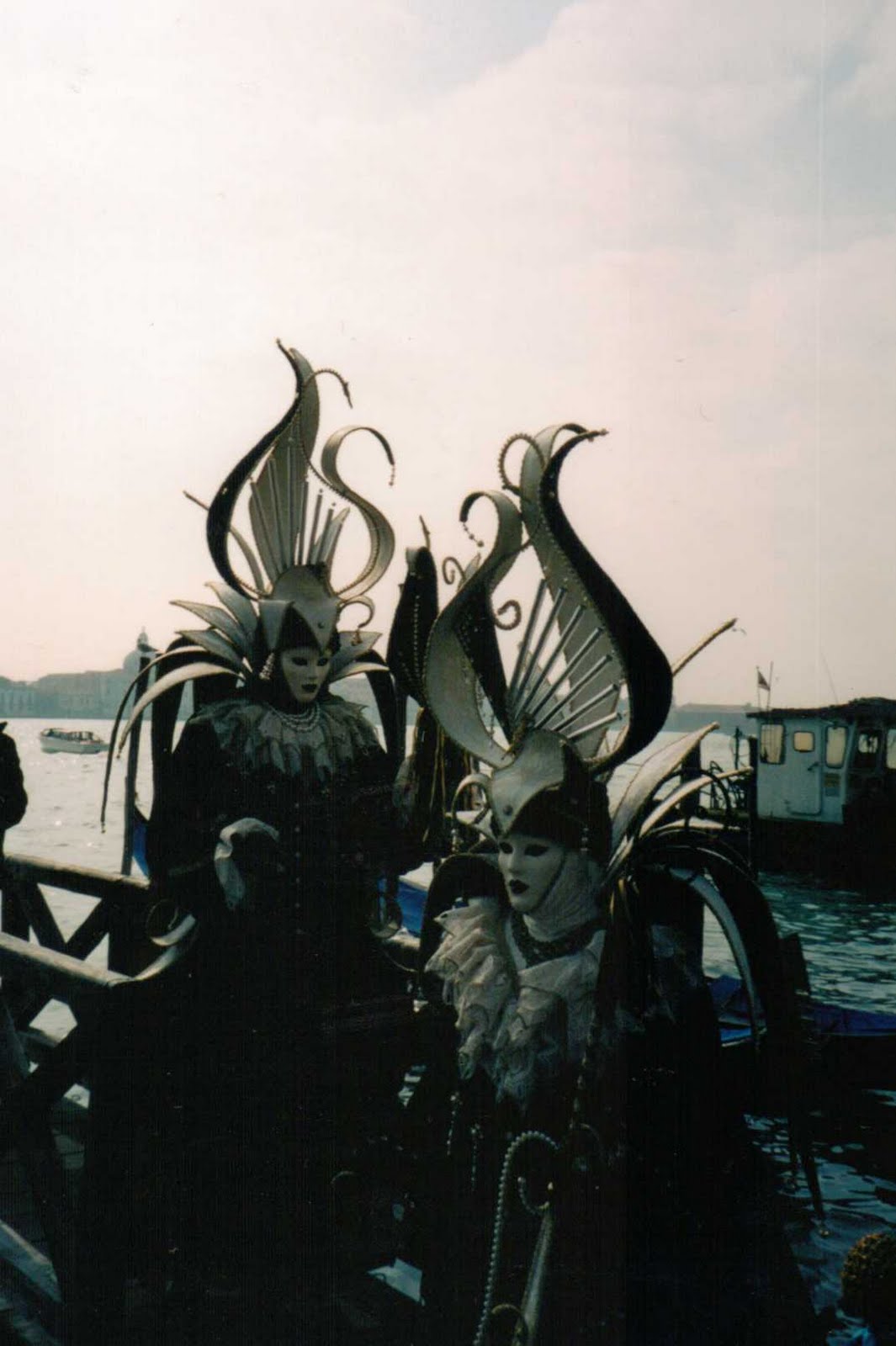
The Carnevale in Venice takes place every February as it has done for centuries. The masqueraders provide a surreal spectacle around the tourist hotspots and are even more dramatic if you encounter them sweeping around a corner in the back-streets away from the crowds.

Even in winter, Venice, although cold, is very bright and the quality of the light is like nowhere else. At night, it is very quiet and I was forever experiencing flashbacks to one of my favourite films, ‘Don’t Look Now’ (the only film to ever give me nightmares as an adult – thankfully we didn’t see any serial-killer dwarves in red hooded coats during our visits).

The light wasn't too great however, when I took this picture of a couple of those masqueraders on a bridge in Venice during our visit in 2002. It is kind of darkly atmospheric though...

JOE THE GORILLA


There – behind the reinforced window
In a chamber of tiles and televisions –
Which is a cage all the more
For the absence of bars,
Smoulders silverbacked Joe,
In an attitude of unyielding dignity
That is a continent beyond
What I suppose to be his sadness and my pity.

Doors open and close on the holiday sun
As harassed humans filter through,
Pulled by children in search of ice-creams
And rides and all the other fairground fun
So thoughtfully provided by the leisure-park zoo.
A glance at Joe, a glance at the flickering screens
And they pass him by –
This being so wholly himself –
Like a something on a supermarket shelf.

And what kind of life is this, Joe?
The question is more than merely rhetorical -
Dare to look deep in the eyes of the oracle –
Joe Gorilla knows.


(1982)


Lise and I visited Chester Zoo recently – the first time we’d been to a zoo together. We both have ambivalent feelings about the places but were generally impressed with the size and layout of the enclosures at Chester. I had a less favourable impression of the zoo featured in this poem (Whipsnade, I think).

The gorilla became something of an animal celebrity and lived to a ripe old age so maybe he wasn’t quite as fed up as he looked. Alison and I had taken Ramona, who was about four at the time, on the trip. I remember we stood with a gaggle of other visitors at the glass window of the tiger’s enclosure, a long run which it was cantering up and down. Suddenly it stopped on the other side of the glass and pissed voluminously all over it and, metaphorically, all over us too, I suppose, as far as he was concerned. An eloquent moment. Never quite managed to put that one in a poem, though…

Ted Hughes wrote great poems about animals that were in captivity and in the wild and I’m aware that his work casts a long shadow. This poem wasn’t an imitation of him but I guess there may be some similarities. Never mind, eh?


THE LILY OF MY LIFE


Grandad lied about his age in World War One;
Got gassed; came back to years on the dole;
Worked out his life at the cemetery;
Dead and gone by the time I was three.

Grandma never once used a telephone;
Was even nervous about radio
And switching on appliances and the TV;
But oh, she was always there for me.

In a storm, she turned the mirror to the wall;
Put away the cutlery then hid in the hall;
Yes, she was afraid of all electricity;
But she was always brave for me.

Lived a cold, hard life in a grey city slum;
Raised her children - two uncles and my Mum -
In a sunless street by a high factory wall
And she was always there for them all.

Then cleared by the council to a new house
On a crescent by a green roundabout
With lawns, a shed and a lilac tree,
Where I would play happy and free,

When I escaped from the Hell House
To her cosy, cold-water, corner terrace;
Time and again the regular refugee,
In the house that was a second home to me.

Torn from her head the silky white hair,
One dark night when Mum and I sheltered there
From him who attacked her most brutally,
Whilst she was busy protecting me.

And Grandma would take me to the Co-Op
And hand in hand, we’d go from shop to shop
Trawling up and down that little community
Of Narborough Road, my Grandma and me.

And, later on, I would lean in to steady her
Arthritic body and take her to the butcher,
The baker and grocer - the places she had taken me,
Safely away from my warped and broken family.

I lived with her during her last crippled years
And although that mixed up kid cried the tears
And somehow knew that his childhood was done,
He didn’t really know what he’d had ‘til it was gone.

Born before the twentieth century,
Lily Weldon came into this life a nobody
And seventy-nine years later, she left it still a nobody,
But afterwards and always, she was a somebody to me.


(2011)

My Grandma was a lovely old lady who lived a long life for that time - and considering the physical frailty that increasing blighted most of her life. My Grandad died in 1955, having worked as a verger at Gilroes Cemetery for most of his life. Perhaps it’s from him that I get my fascination with graveyards. Grandma died in 1970 when I was eighteen and I really don’t know what I would have done without her from about 1957 onwards, following Mum’s divorce from my father.

Being a fairly typical selfish teenager with more than my fair share of angst, I didn’t always treat her as well as I might have done towards the end and I often wish I could turn back time and take with me some of the compassion and patience that I often lacked back then.

‘Always there for me’ is a threadbare phrase these days, but it was literally true in this case. I’m not sure exactly where or when the photograph was taken: maybe Bournemouth or the East Coast somewhere c. 1956. It’s one of my favourites but I can’t help but notice that the angles are weirdly askew, as if things are starting to tilt…


Tuesday, 18 June 2013

UNDERRATED ALBUMS # 14


‘Gimmicky though its premise is, this record achieves a compellingly authentic sound, and the sheer chutzpah of its performances, especially on the more surprising titles, make it a concept album to treasure.’
 
Gravelands (1998) by The King

During the late 1990s, before the DJ and TV presenter Jonathan Ross had floated off in a cloud of egomania all the way up his own sphincter, he used to co-host a very entertaining Saturday morning show on BBC Radio 2 with his friend and producer, Andy Davies, who chose most of the records played. It was whilst listening to this show that I first heard one Jim Brown, a Belfast postman and part-time Elvis Presley imitator. Under the soubriquet, ‘The King’, he had just released an album of classic songs by dead pop stars which, with inspired gallows humour, was titled Gravelands. The record mainly featured the kind of material that would have passed the real Elvis by: which is to say that he very probably wouldn’t have ever heard such songs, let alone recorded them himself*1.

The record opens with two of the three songs which were recorded by the original artists after Presley’s death in 1977: Nirvana’s ‘Come As You Are’ and Joy Division’s ‘Love Will Tear Us Apart’ (the third is Frank Sinatra’s ‘New York, New York’ which closes the set). What is immediately evident is the quality of Brown’s voice and the playing of his band. The voice is rich enough to fool many people into thinking it actually is Presley and the musicians sound like they’re a real band as opposed to session players. Compared to the rather murky tones of the late Ian Curtis, Brown’s voice is a model of clarity and he really lets his tenor go at the end of the Joy Division number in arresting style.

Tim Buckley’s ghostly ‘Song To The Siren’ is then given an eloquent reading and you begin to mournfully wonder at just what great things the later period Presley might have been capable of if he’d only had the gumption to break out of his bubble. The King’s approach to the songs, by the way, is reasonably straightforward – we’re not talking deconstruction here. The version of the traditional Irish ballad, ‘Whisky In The Jar’, for instance, is a slightly more modulated following of Phil Lynott’s arrangement for Thin Lizzy, which adds a fiddle solo to good effect. The production sound (by Bap Kennedy & Martin Smith in the exotic environs of Garage Studios, East Grinstead) sometimes lacks a little atmosphere and depth, but given what was probably a small budget, the band do an excellent job of setting the scene for the main attraction of Brown’s voice.

‘I Heard It Through The Grapevine’ works well with its backing singers and guitar solo and everyone certainly seems to be enjoying themselves on ‘Blockbuster’, which comes complete with siren. One of Chinn & Chapman’s string of Glam Rock hits, it’s refreshing to hear Brown’s deep facsimile mannerisms instead of The Sweet’s shrill histrionics. The eclectic turnover of genres continues with a comfortable pass at Lynyrd Skynyrd’s rolling ‘Sweet Home Alabama’ before the daring selection of John Lennon’s ‘Working-Class Hero’. The fiddle is back on this and, of course, The King body-swerves the ex-Beatle’s effing and blinding, just as the real Presley would have done - in the unlikely event of him ever recording such a song (although his substitution of ‘godamned’ instead of ‘fucking’ may well have also been too profane for Elvis). If ever there was a real working-class hero, then Presley certainly fitted the bill and Brown’s selection and execution of the song is inspired.

The album’s only song from the 1950s – except for the unlisted ‘phantom track’ at the end, ‘That’s Alright, Mama’ - begins mildly enough, until Brown announces, ‘Hold on fellers, it just ain’t coming’, whereupon the band crank up the riff of Eddy Cochran’s ‘Something Else’ a’ la The Sex Pistols. ‘Yeah, that’s better!’ proclaims The King and they’re away. Of course, Cochran did his best to sound like Presley while they were both alive, and this works wonderfully well with Brown whooping it up in very satisfying style. The Small Faces’ ‘All Or Nothing’ isn’t quite such a success, largely because Steve Marriott owned that song and always will do.
 
Presley himself might have wondered what the hell he’d been given if he’d ever perused the Marc Bolan’s nonsense lyrics for T. Rex’s ‘Twentieth Century Boy’, but Brown and the band attack the song with gusto. The next two choices are songs which you can easily imagine Presley actually recording: Otis Redding’s posthumously released ‘Dock Of The Bay’ and the evergreen soul standard, ‘Piece Of My Heart’. Brown handles these classics - both of which feature saxophone - with aplomb.

The following three selections are audacious: ‘No Woman, No Cry’, ‘Voodoo Chile’ and ‘Whole Lotta Rosie’*2. Bob Marley’s breakout hit works just fine with a Dylanesque harmonica solo and Brown - cleverly noting a melodic similarity between the songs - quoting from ‘Can’t Help Falling In Love’ at the end. Any guitarist covering the posthumous # 1 by Jimi Hendrix has to be on the top of his game, as is Brown’s man here. Brown’s ad lib, ‘You can stick pins in me anytime, baby’ will make you smile and you can imagine Presley in some alternative universe going through his karate routine with the lyric: ‘Well, I stand right next to a mountain / Chop it down with the edge of my hand’.

AC/DC’s rock juggernaut charges along at a fabulous rate and is considerably enhanced by delirious crowd encouragement (there’s also crowd noise at the beginning and end of ‘Piece Of My Heart’). I don’t know if this is an actual live recording – I suspect the audience is overdubbed. In any case, it does suggest that the album may well have been more atmospheric if the experiment had been sustained across the whole programme.

The razzamatazz of ‘New York, New York’ provides a fitting finale before ‘That’s Alright, Mama’ is presented as an afterthought – and you’d need exceptionally good ears to distinguish it from the original. But then, gimmicky though its premise is, this record achieves a compellingly authentic sound, and the sheer chutzpah of the performances by Brown and the band, especially on the more surprising titles, make it a concept album to treasure.

On the follow-up album, Return To Splendor (2000), Brown and co. sound even more assured. It’s a convincing companion piece and if the song selection is a little more conservative, then the more adventurous choices are well worth the price of admission (i.e. The Rolling Stones’ ‘Sympathy For The Devil’; The Doors’ ‘L. A. Woman’; The Sex Pistols’ ‘Pretty Vacant’ and a particularly lascivious version of Led Zeppelin’s ‘Whole Lotta Love’).

Sadly, neither album charted and The King subsequently abdicated his way back into obscurity, although he seems to have maintained quite a busy career back in Ireland. Apparently, he contributed some soundtrack work to a 2008 film called Lonely Street.

Elvis Presley imitators are ten a penny, but the originality of these albums by The King puts Jim Brown and his band into a different league. Elvis fans will be impressed by the uncanny vocals whilst music lovers in general will thrill to the audacity of the project and the poignancy of hypothesising of what might have been had Presley not allowed so much of his talent to be squandered.

 
N. B.

*1 – Following his stint in the US Army, Presley rarely had much active input in the material he recorded outside of the odd Gospel album. Cosseted and secluded by manager, Colonel Parker and his ‘Memphis Mafia’ of buddies, sycophants and parasites, aligned with record company RCA’s priority of keeping him churning out albums which were almost as pathetically poor as the thirty-odd films they soundtracked, Presley had pretty much ceded all creative control over his career. It had become all but impossible for writers attempting to pitch their songs to him directly; instead a complex system of preferment via the entourage and RCA’s A & R department prevailed, sometimes involving bribery, sometimes sheer luck. Michael Guralnick’s forensic two-part biography, Last Train To Memphis – The Rise Of Elvis Presley (1994) and Careless Love – The Unmaking Of Elvis Presley (1999), is particularly illuminating on this tragic and tawdry waste of Presley's potential.

*2 – Google ‘Jim ‘The King’ Brown – ‘Whole Lotta Rosie’ and find a very good, professional video of him and the band performing the song in a cabaret scenario.

GHOST STORY


Returning from the grove of grass and stone,
Grievers gone away, I am left alone
To wander these cold rooms broken-hearted,
Searching for the soul newly departed.
Your scent is everywhere, like morning dew;
As fresh as ever, unmistakeably you.

The house is empty now – less like a home –
With all life gone, waiting more like a tomb.

And how will I bear so heavy a cross?
How to rise above such deep, aching loss?

But in the garden, I think I see you
Standing by the trees, still as a statue.
Then you turn, pale, tearful; begin to walk
Towards me; but now when I try to talk,
You shake your head and pass through me blindly,
And wander into the house behind me.

The day is done, the summer sun has shone.
Dusk fades down. Now even your scent is gone.


(2006)


As the title suggests, this poem is a fiction. It did, however, arise from an actual funeral from which I had returned: that of my ex-wife’s grandmother. I had been very fond of Granny Dolly who was buried in the small churchyard of the village where she had lived.

But this poem is not about Granny Dolly. I had stood in our garden thinking over the funeral that evening and listening to the rustling of the leaves, when an uncanny impulse made me wonder whether I was there at all.

I wrote a very vague outline of the poem shortly after but didn’t finish it for several years. That shake of the head towards the end came, I’m sure, floating up through my subconscious, from the red-hooded dwarf that murders the character played by Donald Sutherland at the climax of the film ‘Don’t Look Now’. He’s so sure the figure in red that he’s been pursuing through the dark, foggy backstreets of Venice is the ghost of his recently drowned daughter, but when the dwarf turns to finally reveal herself, she shakes her head before delivering a terrible coup de grace...

The photograph of Lisa is much more recent than the actual poem but it only occurred to me the other day that it might be the right image to go with the poem.

OBJET TROUVE


On this fine April day with great clouds
Rolling overhead, coolness vying with warmth,
I am photographing daffodils in the park,
Pointing the camera at bright splashes of gold
On the grassy slopes and in small clumps
Around the dusty roots of waking trees,
When something seems to flash silver
In a surge of sunshine streaming fresh
Through the emergent leaves high above.

Squinting at the shrubbery, I find I am
About to photograph a photograph:
An eight by ten, black and white shot
Of two Asian girls in traditional finery -
Indonesian perhaps - sat cross-legged,
Their sequins and pearls glamourizing
What looks to be a mundane, functional hall,
Where this sliver of sun has now found a window
And caught the silver of their head-dresses.

I’m struck that it may be a wedding celebration,
And the girls are singing some hymn of praise,
With their faces immaculately painted and hair
Swept back, they are a picture of elegance.
Behind them a vague, banal jumble of wires,
Speakers and amplifier, but inside the moment
The girls are transcendent, the more beautiful
Of the two enraptured, with her eyes closed,
Fingers outstretched to capture some sublime note.

I pick up the picture, place it carefully in my bag
And wander back along the dappled, breezy path
Wondering, along the way, about the bride and groom
And wishing them well on this auspicious Spring day.


(2011)

That’s the actual picture, which I found on Abbey Park near where we live in Leicester.

‘Objet trouve’ - with an accent on the ‘e’ - is French for ‘found object’ and the idea – from the French – is that ordinary everyday things can be found to have inspirational qualities and be used for artistic purposes. I was going to call the poem ‘Found Object’, but it’s not the most elegant phrase, is it?

Pretentious? Moi?

THE DILEMMAS OF TIME & CHANCE


When it’s nearly midnight and at last you’re asked to dance,
Will you step into the arms of a prince or a dunce?
Do you seize the moment, will it only come once?
These are the dilemmas of Time and Chance.

Call it Kismet, call it Karma, call it Destiny or Fate,
Just be careful when you go out waltzing on a date -
That man of your dreams may be a nightmare full of hate -
So don’t turn up too early, but oh, don’t arrive too late.

So is it to be carpe diem or que sera sera?
Were you born under a lucky or an unlucky star?
Will you amount to nothing or will you go far?
If you miss the last boat, will you thumb down a car?

They say Time’s a healer, it will lead you by the hand
To follow the footprints leading away in the sand.
They say grief will pass when you reach that other land
Where life goes on and you must finally make a stand.

Now those vows you made for better or for worse,
Will they deliver the blessing or do they bring the curse?
But Chance is the dealer and you may win or you may lose -
Are the aces played low or high - which of them will you choose?

And it is said that what goes around will come around
And for everything lost something else will be found,
But listen to that sound, that awful, grinding sound -
Can that be the Wheel of Fortune breaking down?

Now you see you’re caught between a hard place and a rock
And the hands are a blur on the face of the clock.
Is there still enough time to reflect and take stock?
You find the key, but no guarantee and there may not be a lock.

Back at the ball, see the mysterious masquerader advance;
That swirling of his magical cloak is meant to entrance.
Will this be your very last appointment with romance?
These are the dilemmas of Time and Chance.


(2011)

Started a while back but only licked into shape now. It’s really just an exercise in compressed rhyme and having a little spooky fun with the basic idea of coincidence.